The crummy old sound system, the new Bose, the crowded audi, the riotous Egyptian/ballroom dancing/crawling behind the band, the weird noises from the music club at night, the corny songs, the smashhit songs, the catcalls... it's good to know at least some of that still lives on.
It was a fun four years. And you rocked again this Diwali, guys.
Pegu, Harshat, Riaz et al. at Gurgaon:
Kandisa
Mora Sainyan (Fuzon)
Roobaroo
Pal
Dooba Dooba (and just a bit of Smoke on the Water :P)
... and Biplab, Dipanjan et al. at Pittsburgh:
Maa Rewa
Wednesday, November 01, 2006

Wednesday, October 18, 2006
Cow Poetry
Distant Hills
The distant hills call to me.
Their rolling waves seduce my heart.
Oh, how I want to graze in their lush valleys.
Oh, how I want to run down their green slopes.
Alas, I cannot.
Damn the electric fence!
Damn the electric fence!
Thank you.
(by Gary Larson in "The Far Side". The original image, showing a cow reciting the above in front of an audience of cows sitting on chairs, is not posted because of this. This post is dedicated to the Diabolic Dancer, who introduced me to Cowabduction.com.)
The distant hills call to me.
Their rolling waves seduce my heart.
Oh, how I want to graze in their lush valleys.
Oh, how I want to run down their green slopes.
Alas, I cannot.
Damn the electric fence!
Damn the electric fence!
Thank you.
(by Gary Larson in "The Far Side". The original image, showing a cow reciting the above in front of an audience of cows sitting on chairs, is not posted because of this. This post is dedicated to the Diabolic Dancer, who introduced me to Cowabduction.com.)
Monday, October 16, 2006
Har soz mein har saaz mein maujood hai tu
Yeh zameen jab na thi, yeh jahaan jab na tha
Chaand suraj na the, aasmaan jab na tha
Raaz-e-haq bhi kisi par ayaan jab na tha
Jab na tha kuchh yahaan, tha magar tu hi tu.
Chaand suraj na the, aasmaan jab na tha
Raaz-e-haq bhi kisi par ayaan jab na tha
Jab na tha kuchh yahaan, tha magar tu hi tu.
Friday, October 13, 2006
Kalindikhal - Part 8
23rd July (Suralaya Glacier to Kalindi Base): Great views in the morning:
Today, after some clambering...
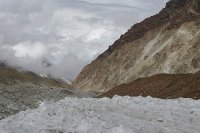
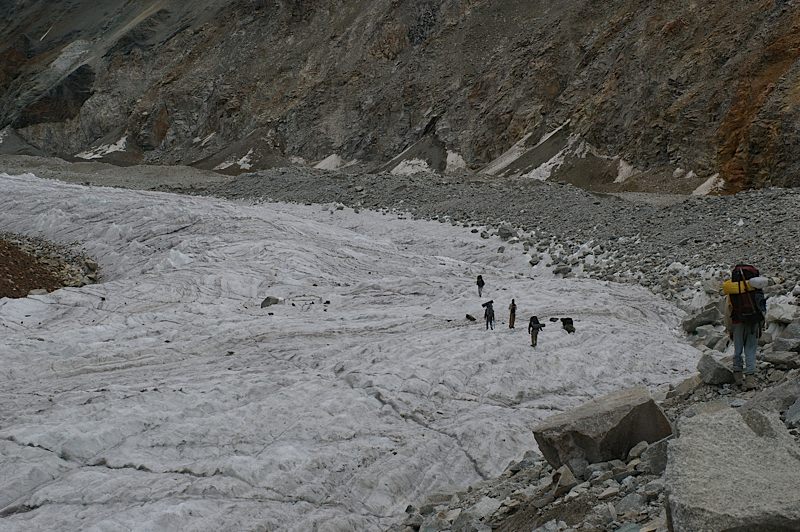
... we got onto a pure white river of ice with, for a change, no rocks on it. This is probably still the Chaturangi, upstream from the point where it is joined by the Sweta Glacier (I haven't found a complete map yet). Here's what it looks like down the valley...
... and up it...

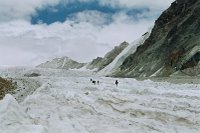
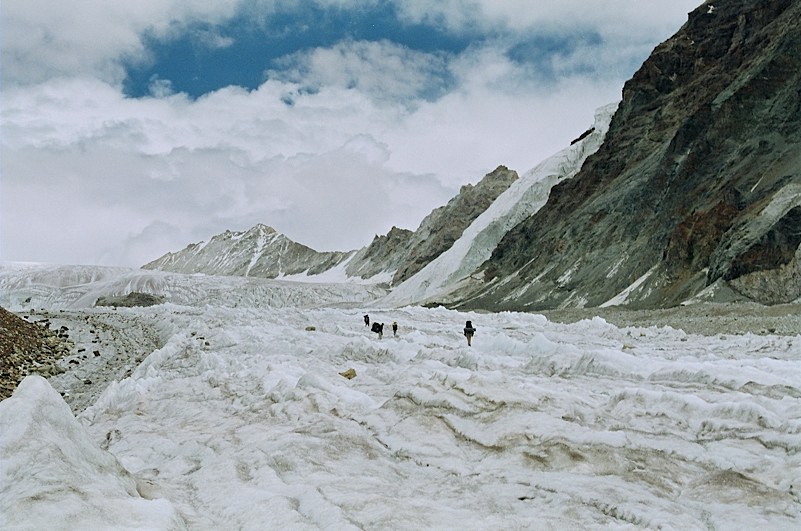
... and even further up, with Kalindi Pass itself running up the centre of the picture, between the white hanging glacier and the darker rock behind it:
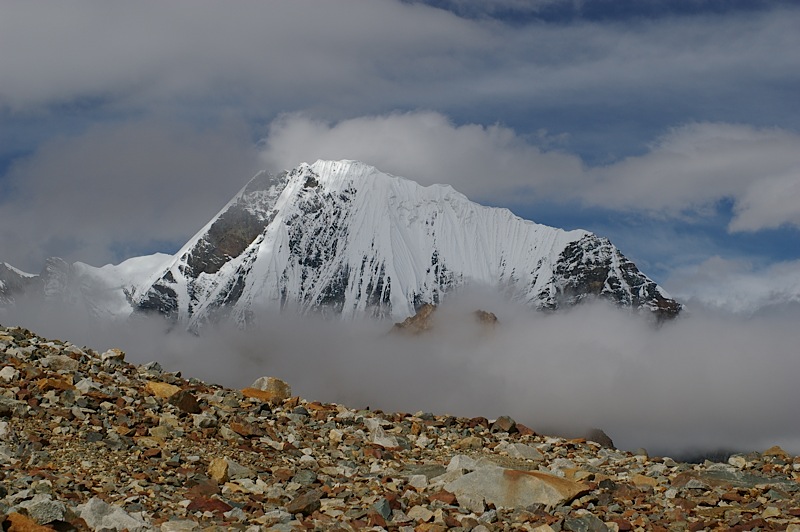
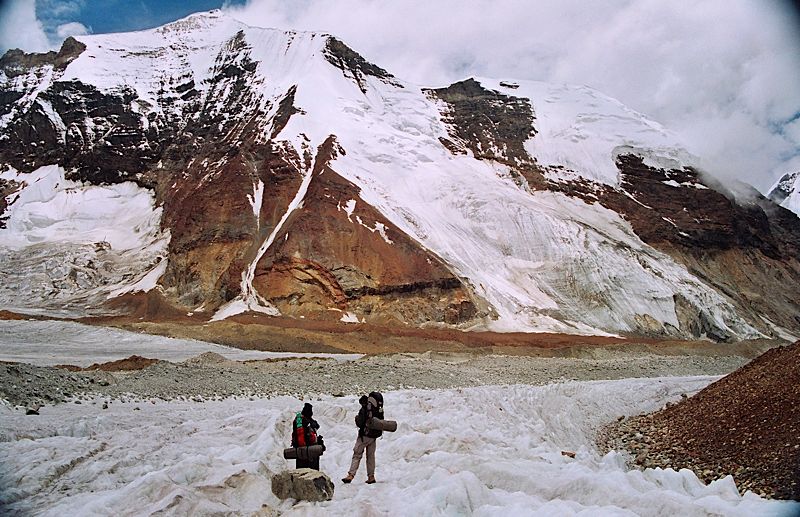
Chandra Parbat was off to our right:

There were little meltwater rivulets running through the glacier, which we jumped across with suitable melodrama :P

... while Vishnu and Mahavir paused to play cards on the ice at regular intervals. I presume this shows some sort of high-altitude savoir faire.

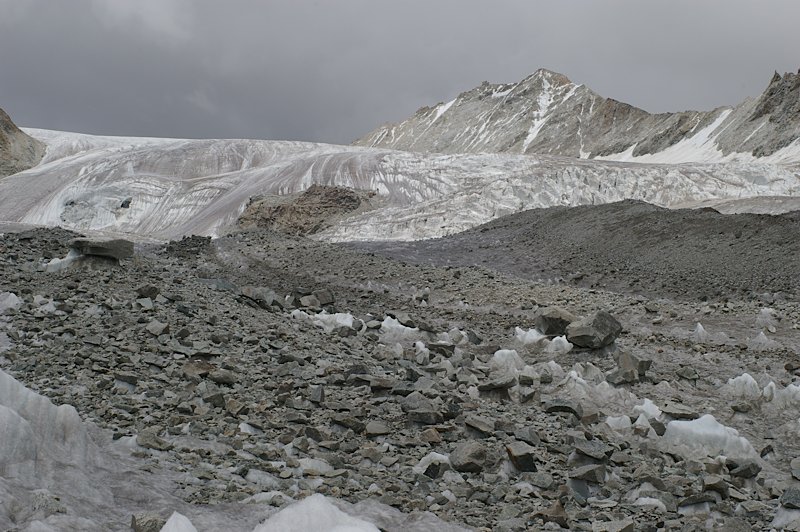
We walked up the glacier to the foot of the pass (~5700m) and pitched camp there. Walking on the ice was surprisingly easy, and not very slippery at all. The glacier had its source in a massive icesheet (coming from China?), whose size is impossible to convey in pictures. Here's an attempt:

And here's our camp right at its rightmost end, where it's all cracked up:

The seracs behind Vishnoi are pretty far beyond him, and are each at least the size of a many-storey building.
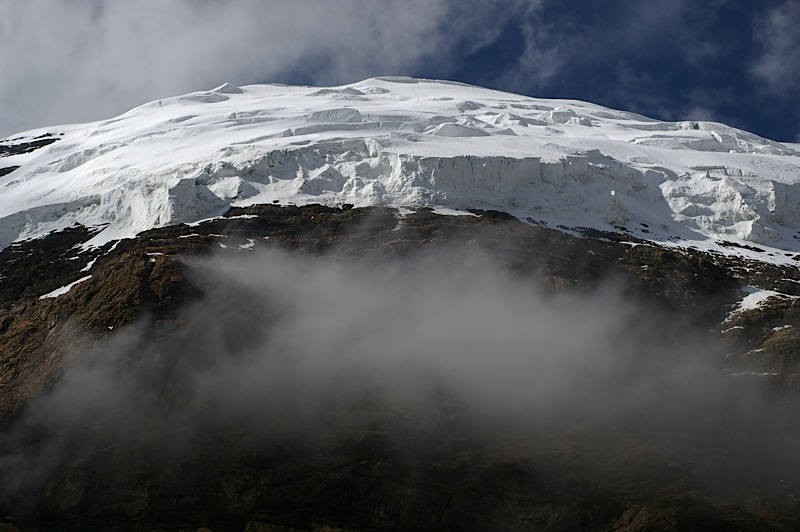
Here's a view up the pass itself. We'll be going up this slope the next morning at the crack of dawn.

We sat outside in the gathering gloom for dinner, then prepared for a very short night -- we'd have to be up at 2:30am and start out by 4:30, to get on the ice before it started growing soft and dangerous in the sun. Vishnu had earlier suggested we might not even sleep tonight ("Nobody sleeps. The kitchen runs all night"), but that plan was shelved and we did get a few hours' shuteye.
(Part 9)
 |  |  |
Today, after some clambering...
 |  |
... we got onto a pure white river of ice with, for a change, no rocks on it. This is probably still the Chaturangi, upstream from the point where it is joined by the Sweta Glacier (I haven't found a complete map yet). Here's what it looks like down the valley...

... and up it...
... and even further up, with Kalindi Pass itself running up the centre of the picture, between the white hanging glacier and the darker rock behind it:
Chandra Parbat was off to our right:
There were little meltwater rivulets running through the glacier, which we jumped across with suitable melodrama :P

... while Vishnu and Mahavir paused to play cards on the ice at regular intervals. I presume this shows some sort of high-altitude savoir faire.

We walked up the glacier to the foot of the pass (~5700m) and pitched camp there. Walking on the ice was surprisingly easy, and not very slippery at all. The glacier had its source in a massive icesheet (coming from China?), whose size is impossible to convey in pictures. Here's an attempt:
And here's our camp right at its rightmost end, where it's all cracked up:

The seracs behind Vishnoi are pretty far beyond him, and are each at least the size of a many-storey building.
Here's a view up the pass itself. We'll be going up this slope the next morning at the crack of dawn.
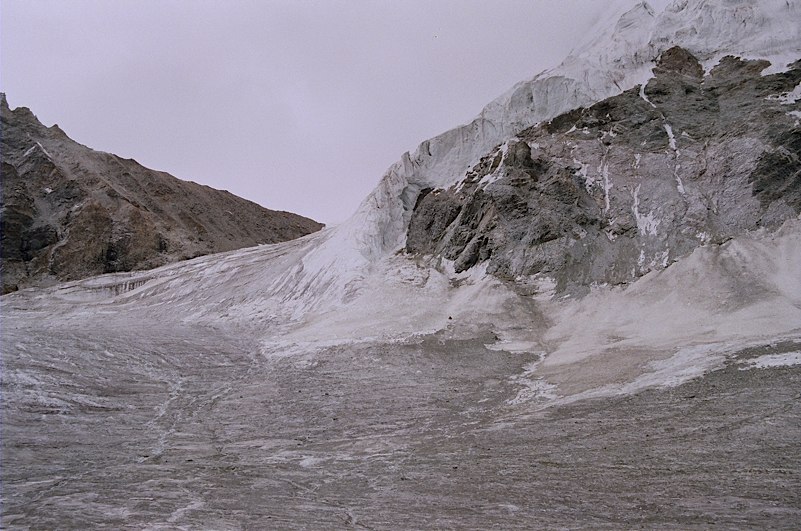
We sat outside in the gathering gloom for dinner, then prepared for a very short night -- we'd have to be up at 2:30am and start out by 4:30, to get on the ice before it started growing soft and dangerous in the sun. Vishnu had earlier suggested we might not even sleep tonight ("Nobody sleeps. The kitchen runs all night"), but that plan was shelved and we did get a few hours' shuteye.
(Part 9)
Kalindikhal - Part 7
(This part was wrongly included in the Day 6 episode. Sorry about the mixup.)
22nd July (Khada Patthar to Suralaya Glacier, 6km): I started out early today, and moved ahead with Vishnu. We got onto the glacier fast. The glacier was covered with rust-coloured rock. We'd heard the name "Raktabaran" ("blood-coloured") applied to one of the ice-rivers here. It could have been this very one (Update: according to a map I've just located, it wasn't), possibly as one of the four colours of the Chaturangi (which literally translates to "four-coloured") glacier. As is no doubt evident, my glacial geography is rather weak. Vishnu had passed this way a couple of weeks ago with another team, and he scouted out the trail of markers, little piles of stones, that he'd placed then. We moved ahead at a rapid pace, and I enjoyed the feeling of being at the front for once. After a while, we caught the most fantastic view of Satopanth, gleaming blinding white only a short distance away.
Vishnu was going to guide an army expedition up the mountain right after our trek. He pointed out the route to the summit: up the snow ridge starting between the two large black horns (standing out in the middle picture).
I think something about the views of the peaks today invigorated us. I can speak for myself, at least -- normally I'm pretty slow and steady, but today I felt like racing ahead all the time.
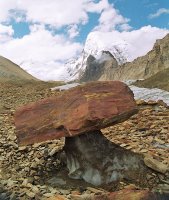
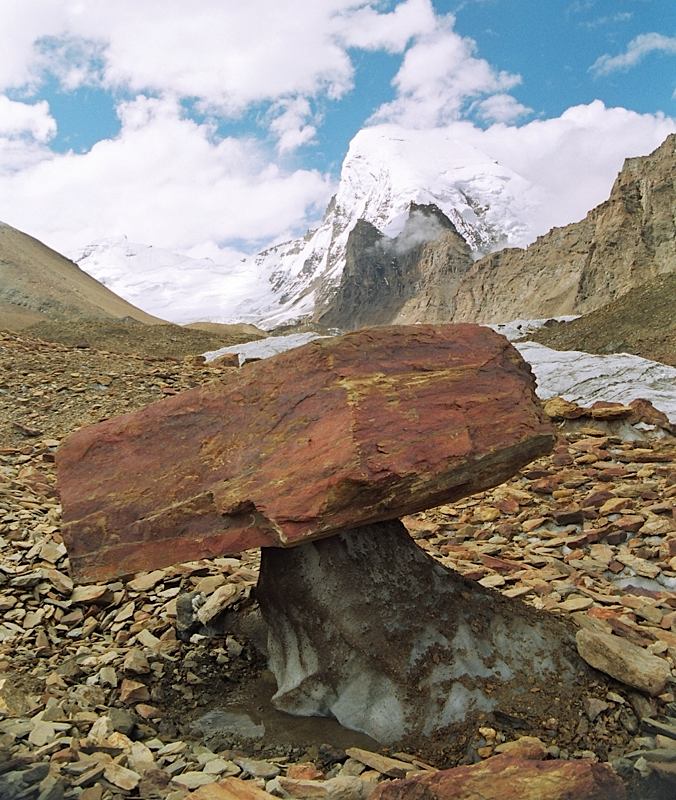
We also passed some interesting ice mushrooms -- large flat rocks carried down by the glacier under which the ice has partially melted, leaving them perched on frozen pillars.
And then this interesting little traverse of a knife-edge ridge of ice: normally, a glacial ridge has a sheer drop to on one side and rubbly, gentle slope on the other -- one walks just below the edge on this rubbly side. For this short stretch of maybe 20 feet, both sides were sheer, slippery ice. Vishnu marched out onto this edge, balancing like a tightrope walker...

... and keeping himself perched upright God knows how, hacked out some footholds on one side with his ice-axe. This took quite some time and the rest of the party turned up as he was finishing the job. I went across first, minus pack and (throwing dignity to the winds in the light of the abysses on both sides) on all fours, putting my hands on the edge and my feet in the footholds. The rest followed in identical fashion, except of course some, or possibly all, of the porters who tightroped across (with packs) like Vishnu.
I hate being a plainsman :(.
I'm to the left of the ridge, and Ajay about to cross it on the right, in the left picture. The right picture is what we'd have fallen into on the other side if we'd slipped. We had a gala time chucking pebbles into this pool after we'd crossed over.
The sheer walls of ice flanking these ridges were quite spectacular. Here's one angle on them:

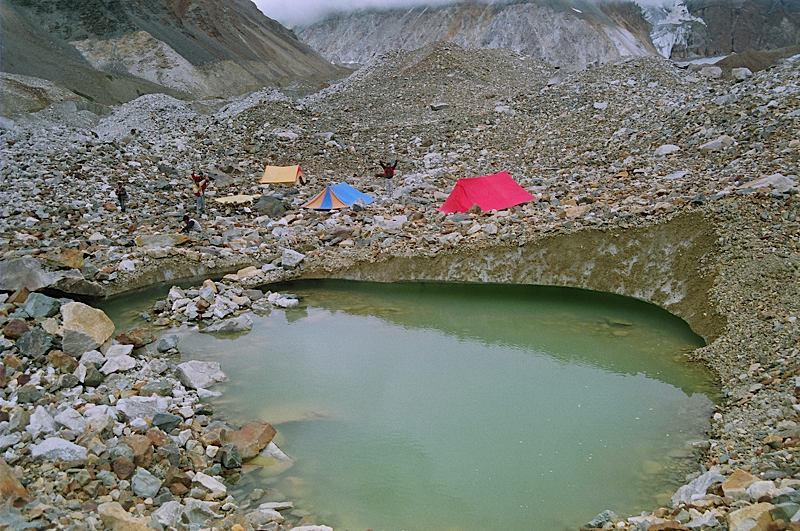
Our camp was on the glacier itself, on a rock-strewn sheet of ice with a little hole for water nearby.

(Part 8)
22nd July (Khada Patthar to Suralaya Glacier, 6km): I started out early today, and moved ahead with Vishnu. We got onto the glacier fast. The glacier was covered with rust-coloured rock. We'd heard the name "Raktabaran" ("blood-coloured") applied to one of the ice-rivers here. It could have been this very one (Update: according to a map I've just located, it wasn't), possibly as one of the four colours of the Chaturangi (which literally translates to "four-coloured") glacier. As is no doubt evident, my glacial geography is rather weak. Vishnu had passed this way a couple of weeks ago with another team, and he scouted out the trail of markers, little piles of stones, that he'd placed then. We moved ahead at a rapid pace, and I enjoyed the feeling of being at the front for once. After a while, we caught the most fantastic view of Satopanth, gleaming blinding white only a short distance away.
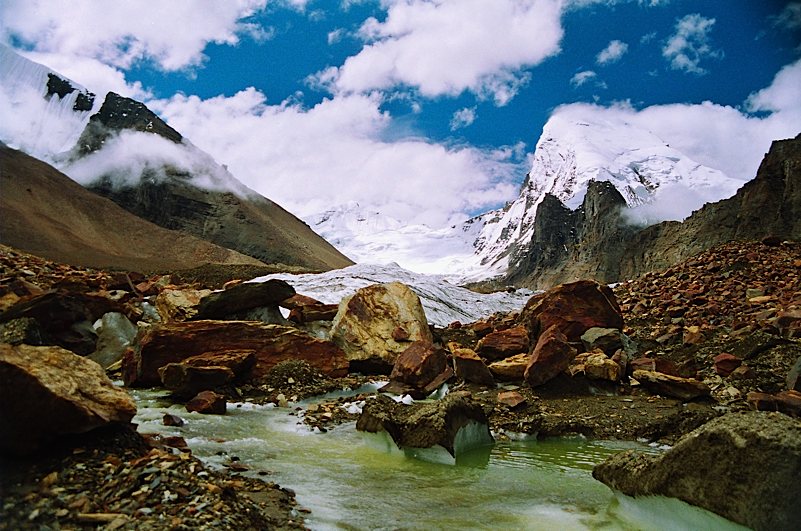 | 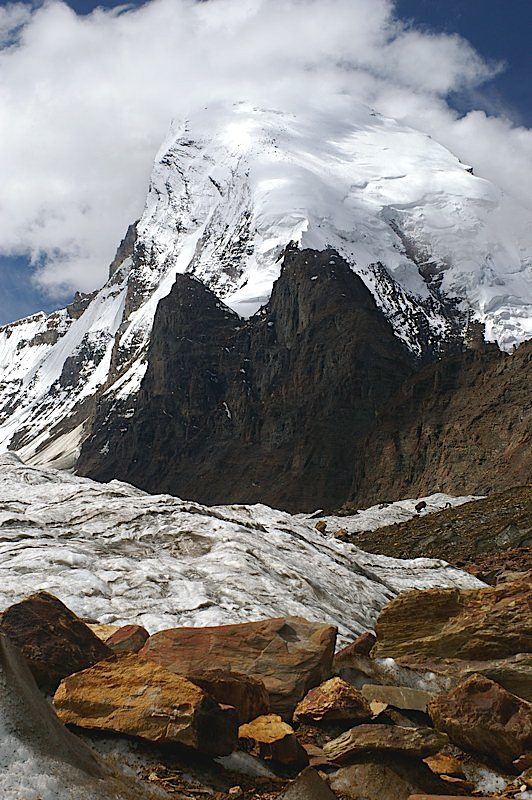 | 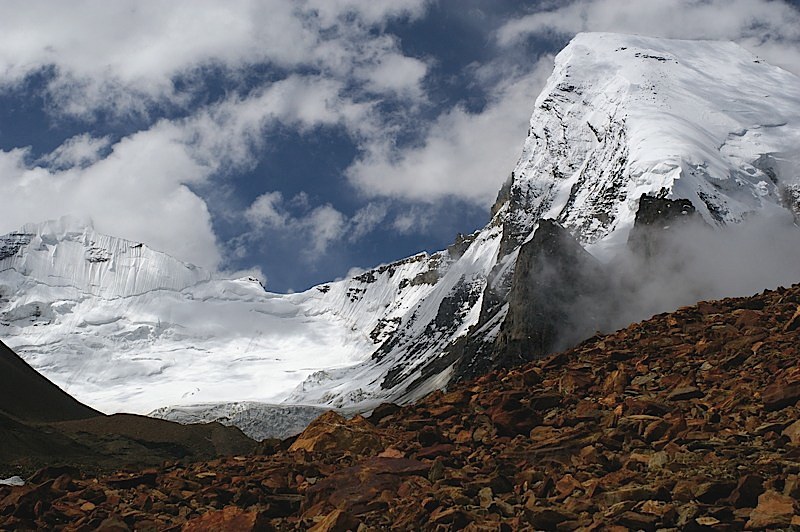 |
Vishnu was going to guide an army expedition up the mountain right after our trek. He pointed out the route to the summit: up the snow ridge starting between the two large black horns (standing out in the middle picture).
I think something about the views of the peaks today invigorated us. I can speak for myself, at least -- normally I'm pretty slow and steady, but today I felt like racing ahead all the time.
We also passed some interesting ice mushrooms -- large flat rocks carried down by the glacier under which the ice has partially melted, leaving them perched on frozen pillars.
And then this interesting little traverse of a knife-edge ridge of ice: normally, a glacial ridge has a sheer drop to on one side and rubbly, gentle slope on the other -- one walks just below the edge on this rubbly side. For this short stretch of maybe 20 feet, both sides were sheer, slippery ice. Vishnu marched out onto this edge, balancing like a tightrope walker...

... and keeping himself perched upright God knows how, hacked out some footholds on one side with his ice-axe. This took quite some time and the rest of the party turned up as he was finishing the job. I went across first, minus pack and (throwing dignity to the winds in the light of the abysses on both sides) on all fours, putting my hands on the edge and my feet in the footholds. The rest followed in identical fashion, except of course some, or possibly all, of the porters who tightroped across (with packs) like Vishnu.
I hate being a plainsman :(.
 | 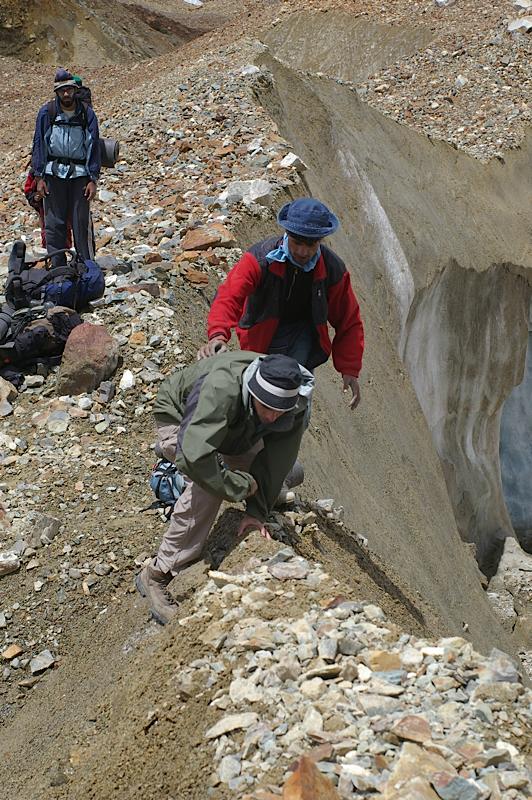 | 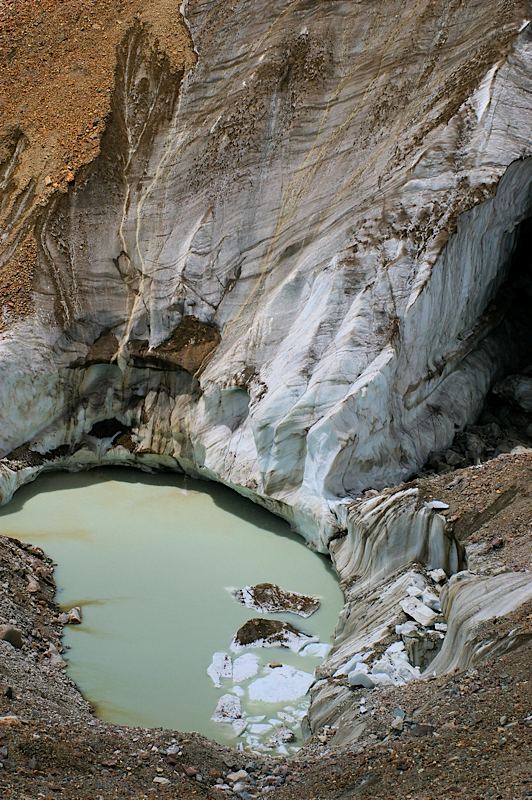 |
I'm to the left of the ridge, and Ajay about to cross it on the right, in the left picture. The right picture is what we'd have fallen into on the other side if we'd slipped. We had a gala time chucking pebbles into this pool after we'd crossed over.
The sheer walls of ice flanking these ridges were quite spectacular. Here's one angle on them:
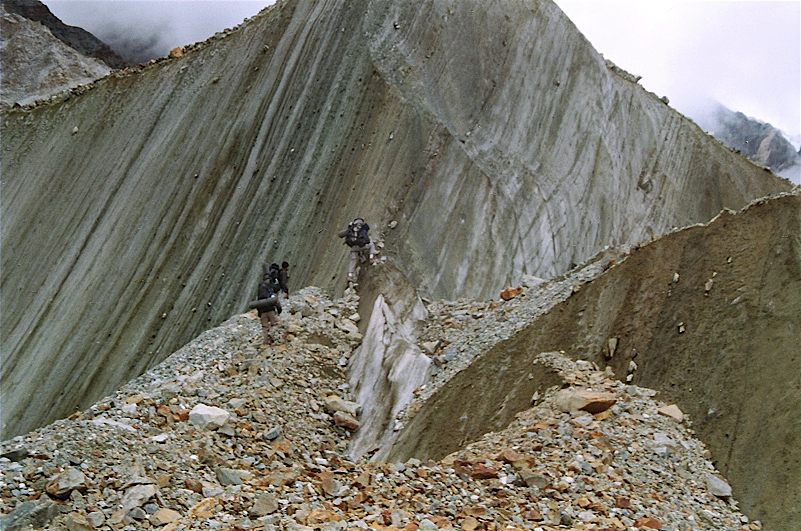
Our camp was on the glacier itself, on a rock-strewn sheet of ice with a little hole for water nearby.
(Part 8)
Saturday, September 30, 2006

Tuesday, September 26, 2006
Re brishti dhore ja, nebur pata koromcha...
"This land of rivers is a land of floods, of great movements of water and the breaking and desolating of banks: Jibanananda Das wrote of the sad green river-shores of Bengal. It has been, well into a period of living memory, a land of famine, natural and man-made. Particularly within living memory, it has been a land of conflict and uprooting and helpless suffering for millions -- more millions than ever in human history on a comparable area of the earth’s surface. (This is statistics not rhetoric.) Much in Bengal’s past is of a piece with its recent predicaments. It was that past which, not so long ago as historical time goes, refashioned a harvest festival in the light of a singular combination of myths to create the unique worship of an eminently protective, eminently affective mother-goddess. That worship has so far retained its vitality, as social though not religious ritual. (The priest is one of the most poorly-paid functionaries at Durga Puja, below the image-maker, and far below the lights technician.) Not all the canned music and electric gimmickry, appropriation by political parties and gut-level street vulgarity, has been able to dispel the latent meaning of the exercise, simply because one must enact it if one goes through the exercise at all.
Durga Puja thus articulates that peculiar vein of sentiment for which the Bengali is marked, not to say stigmatised, by the world and by himself. It can, and often does, degenerate into banal sentimentalism; it induces unproductive stances and ineffectual scruples that prevent it from asserting its place in the world, or from doing any good to oneself or others. But it proves to be a compelling legacy that makes one look at the world in unusual lights, and from time to time makes possible some unusual gift of service or insight."
(Picture of crow at Kumartuli by Amit Datta of The Telegraph, Calcutta, in a rainy September, 2005; words by Sukanta Chaudhuri in The Asian Age, in a rainy October, 1999.)
Saturday, September 23, 2006
Kalindikhal - Part 6
20th July (Vasuki Tal): Rest day. Climbed up small slope next to the lake and did stupid things like this:

Clouds, clouds, clouds.
(I had mistakenly included some of the next day's stuff in the 21 July episode. Sorry about the mixup. It has been fixed.)
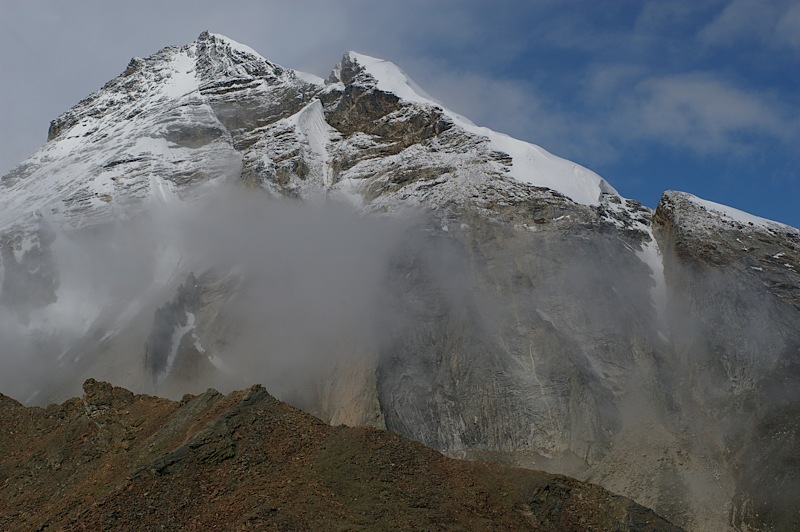
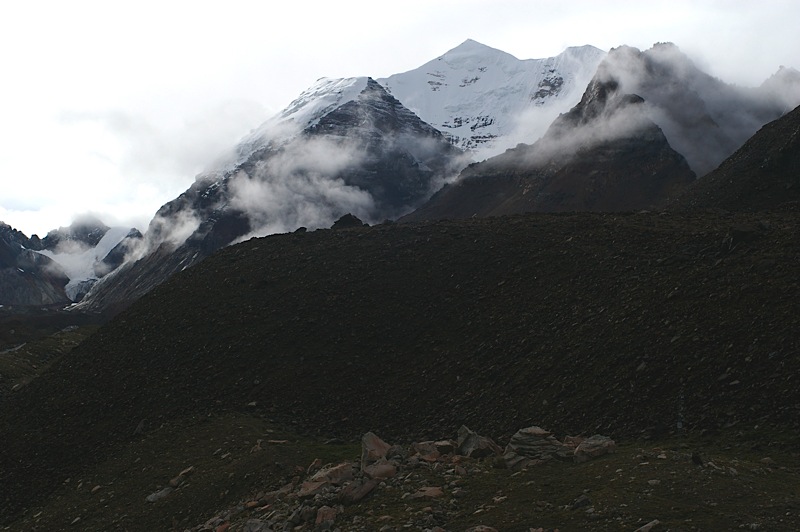
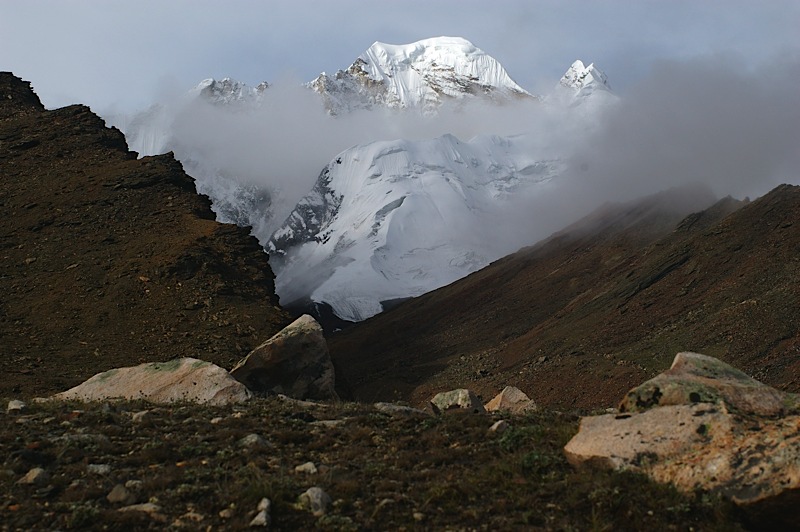
21st July (Vasuki Tal to Khada Patthar, 6km): Clear views in the morning! For once we're all cheerful :). Vasuki, Bhagirathi and a cluster of four peaks we could not identify in the distance, across the lake.
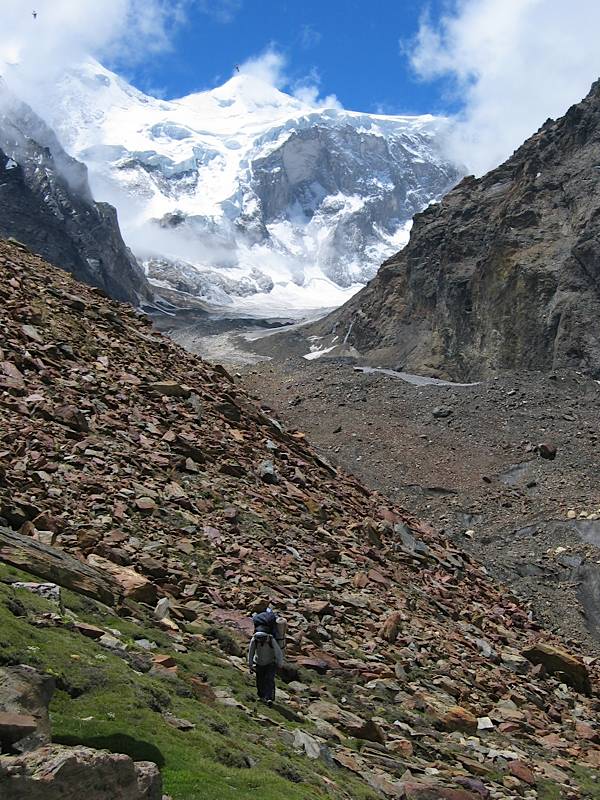
The route today involved yet another glacier crossing, and then climbed up a rocky, grassy slope to Khada Patthar ("Vertical Rock", 5456m), a grassy patch bisected by a stream. Here's Gagan Singh coming up the slope, with the glacier we'd just crossed behind him.

We dumped our packs in camp and walked up a little higher to check out the terrain beyond the surrounding ridges and to climb some boulders. Here we are being monkeymen:
Hiking boots are awful to climb in, btw.
Something about our oh-so-incredible nightlife -- evenings in camp mostly consisted of card games by torchlight, frequently simultaneously in multiple tents. Twenty-nine was immensely popular (I suck at it). Vishnoi, who assumed responsibility for teaching Vladlen the game, started with a stripped-down version and gradually introduced more complex rules as the evenings went by, until he happened to introduce some new rule that totally destroyed an exceptionally good hand held by Vladlen. "Fuck you!" screamed my venerable advisor, "There is no such rule!!! There is no such rule!!!"
Normally, we cook on treks ourselves, but this time the conditions were tough enough for us to assign the job to the porters (we took this decision after the first couple of days, and a subset of the staff pocketed extra shekels for this duty), and they did a great job, relatively speaking, for trek food is rarely palatable. The tomato/garlic soup and morning daliya were big hits.
(Part 7)
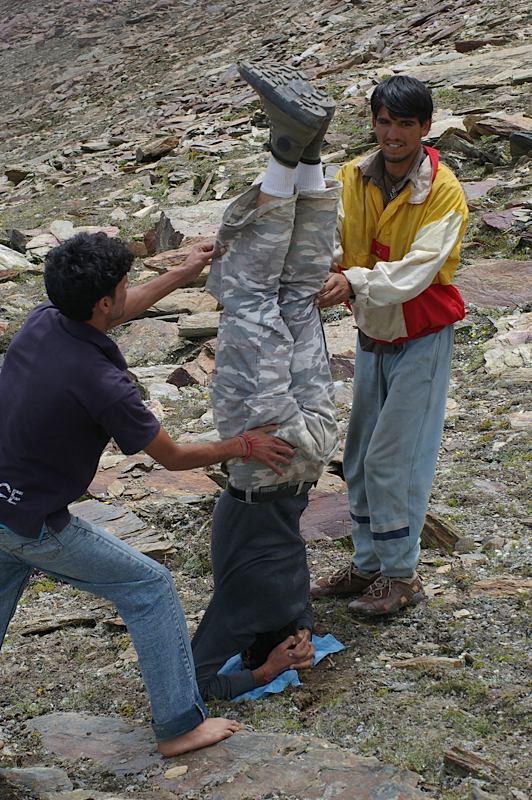
Clouds, clouds, clouds.
(I had mistakenly included some of the next day's stuff in the 21 July episode. Sorry about the mixup. It has been fixed.)
21st July (Vasuki Tal to Khada Patthar, 6km): Clear views in the morning! For once we're all cheerful :). Vasuki, Bhagirathi and a cluster of four peaks we could not identify in the distance, across the lake.
 |  |  |
 |  |  |
The route today involved yet another glacier crossing, and then climbed up a rocky, grassy slope to Khada Patthar ("Vertical Rock", 5456m), a grassy patch bisected by a stream. Here's Gagan Singh coming up the slope, with the glacier we'd just crossed behind him.
We dumped our packs in camp and walked up a little higher to check out the terrain beyond the surrounding ridges and to climb some boulders. Here we are being monkeymen:
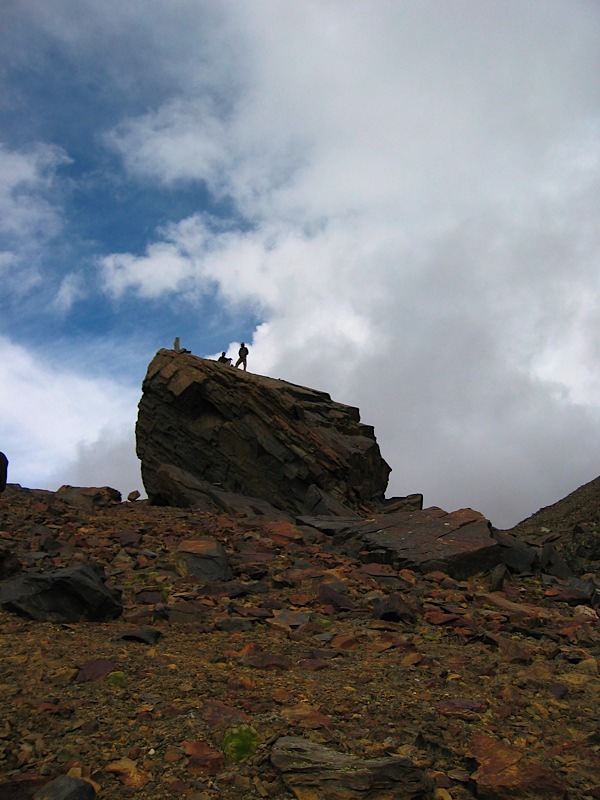 | 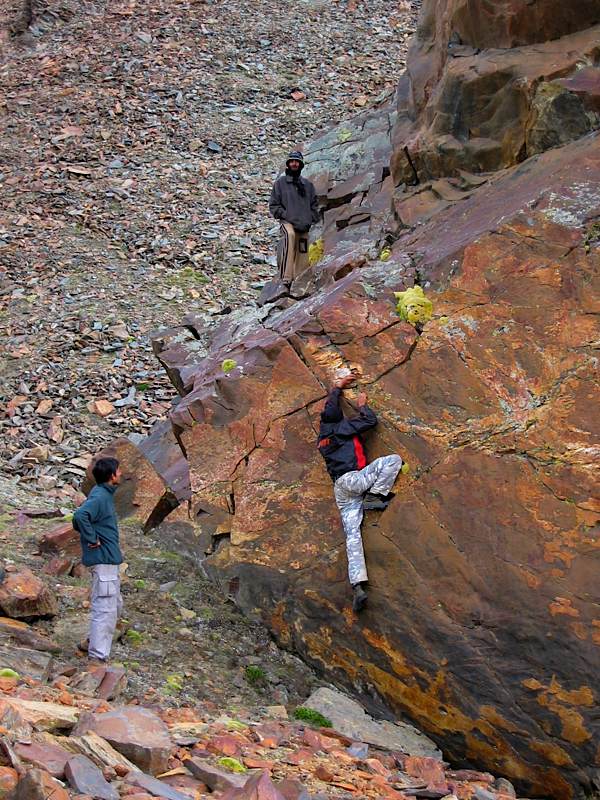 |
Hiking boots are awful to climb in, btw.
Something about our oh-so-incredible nightlife -- evenings in camp mostly consisted of card games by torchlight, frequently simultaneously in multiple tents. Twenty-nine was immensely popular (I suck at it). Vishnoi, who assumed responsibility for teaching Vladlen the game, started with a stripped-down version and gradually introduced more complex rules as the evenings went by, until he happened to introduce some new rule that totally destroyed an exceptionally good hand held by Vladlen. "Fuck you!" screamed my venerable advisor, "There is no such rule!!! There is no such rule!!!"
Normally, we cook on treks ourselves, but this time the conditions were tough enough for us to assign the job to the porters (we took this decision after the first couple of days, and a subset of the staff pocketed extra shekels for this duty), and they did a great job, relatively speaking, for trek food is rarely palatable. The tomato/garlic soup and morning daliya were big hits.
(Part 7)
Friday, September 22, 2006
Yes, even bagpipes.
AAK: He could play about 200 different instruments himself.
SH: Two hundred? Are there that many Indian instruments?
AAK: No, but he had left Bengal and studied Western classical music in Calcutta, so he knew things like saxophone, trumpet, the double bass, bagpipes....
SH: Bagpipes? In India?
AAK: Yes, even bagpipes....
SH: I have heard from other noted Indian musicians that it is common for aspiring musicians to do a kind of musical retreat -- a chilla -- where one spends forty days and nights in isolation, doing nothing but playing. Did you ever do that?
AAK: I did not need to. My father made me practice at least twelve hours a day for twenty years.
...SH: Do you think if we could get, say, the leaders of India and Pakistan, or even of Israel and Palestine, together and force them to really listen to the right music they might see the importance of peace, and work things out?
AAK: Yes. I really do. And why not try this? I think even politicians who are also musicians are going to be more concerned with peace. Look at Clinton, his attitude to the world was different than those who came after him, or others. He had a tune in him.
SH: That's one way of looking at him (laughter)....
SH: Do you like other kinds of music besides what you play?
AAK: Yes, I like Western classical music very much -- Bach and Beethoven. And sometimes country music.
SH: Country? You mean like Hank Williams and Willie Nelson and all that?
AAK: Yes. I like the melodies.--
(Ali Akbar Khan, interviewed by Steve Heilig)
Monday, September 18, 2006
Kalindikhal - Part 5
19 July (Nandanvan to Vasuki Tal, 7km): Woke up in the morning to find the sun out and Kedar Dome white and pristine on the other side of the Gangotri glacier, with Kedarnath peeking out behind it.
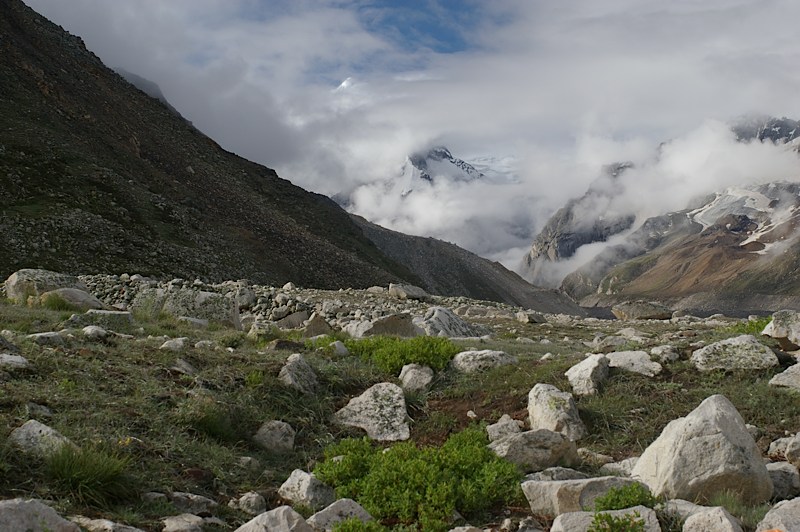
Here're a few more views of Nandanvan:
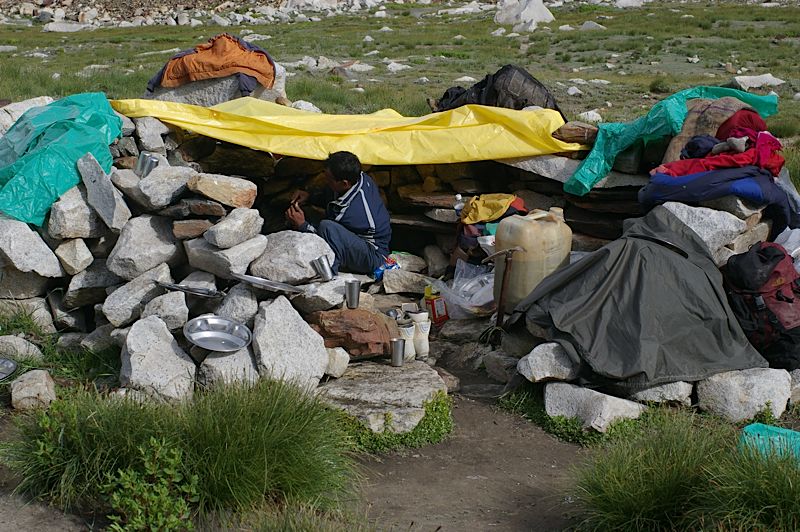
And here's our kitchen. Chandru and Chhota Govind did an incredible job manning it for most of the trip (with help from others), both in the morning and after a hard day's walk.
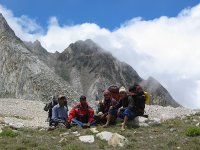
Our route today was chiefly along moraine ridges. Here are some pictures of the route. That's Panda taking a breather in the last picture.
And here are some of our fantastic porters:
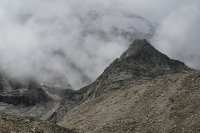
We passed under what was probably Bhagirathi II (6512m), wrapped in cloud. The west face of Bhagirathi III, sandwiched between I and II and hanging over the Gangotri glacier, is one of the great "big walls" of the planet (see, for example, this site by Russian climbers). Here's a glimpse of B II (peer into the clouds in the top half):
We were walking along the Chaturangi glacier, a huge stream of broken ice covered with red rock...

... which developed light and dark streaks as we headed further upstream and tributaries joined it:

Apparently something like seven glaciers merge at this point. The white glacier in the bottom right of this picture is from Bhagirathi II (according to Vishnu). The picture looks in the direction of our route for the next couple of days (we took a left turn under the glaciated black peak in the distance).
The tricky portion of the day's walk was our second glacier crossing -- this time it was the Bhagirathi II glacier mentioned above. It took a long time and much zigzagging to cross, and then there was a steep and tricky moraine wall to climb up (the porters helpfully fixed a rope like a handrail).
(Look closely at the second picture and you can make us out crossing over.)
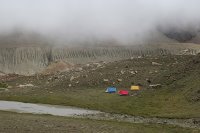
This was the last hurdle of the day, and on the other side of the glacier lay a beautiful green meadow surrounding Vasuki Tal (~4900m). The tal (lake) itself was singularly unimpressive, more a cold, dull pond than anything else.
The itinerary that Vishnoi had copied off the net read:
(Part 6)

Here're a few more views of Nandanvan:
 |  |
And here's our kitchen. Chandru and Chhota Govind did an incredible job manning it for most of the trip (with help from others), both in the morning and after a hard day's walk.
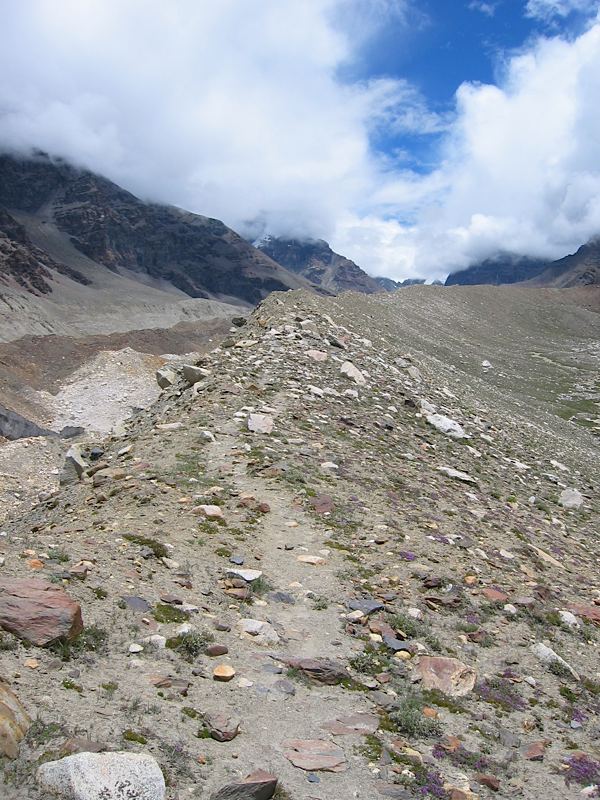
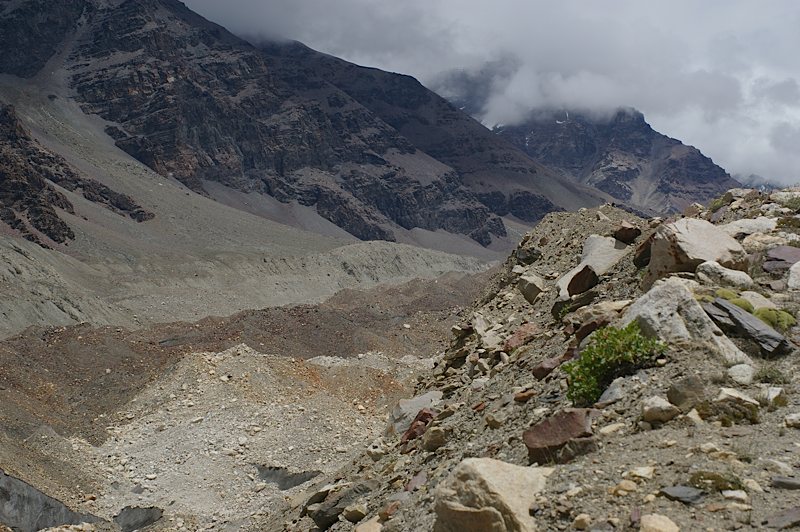
Our route today was chiefly along moraine ridges. Here are some pictures of the route. That's Panda taking a breather in the last picture.
 |  |
 | 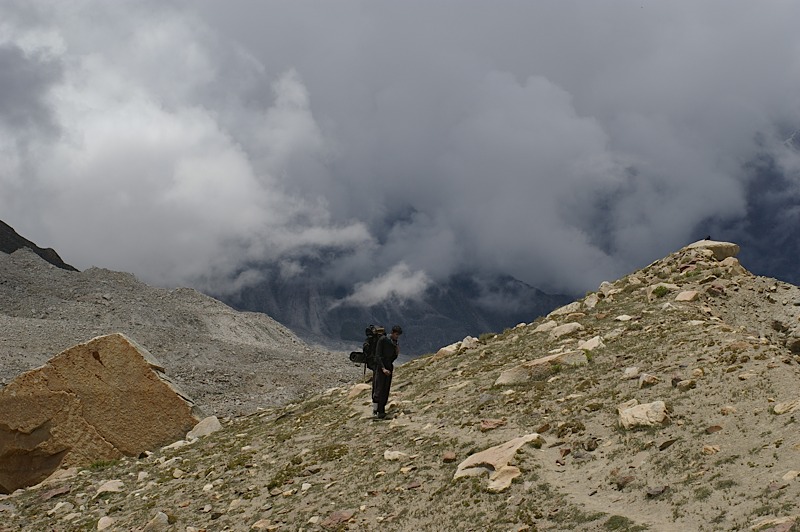 |

We passed under what was probably Bhagirathi II (6512m), wrapped in cloud. The west face of Bhagirathi III, sandwiched between I and II and hanging over the Gangotri glacier, is one of the great "big walls" of the planet (see, for example, this site by Russian climbers). Here's a glimpse of B II (peer into the clouds in the top half):

We were walking along the Chaturangi glacier, a huge stream of broken ice covered with red rock...
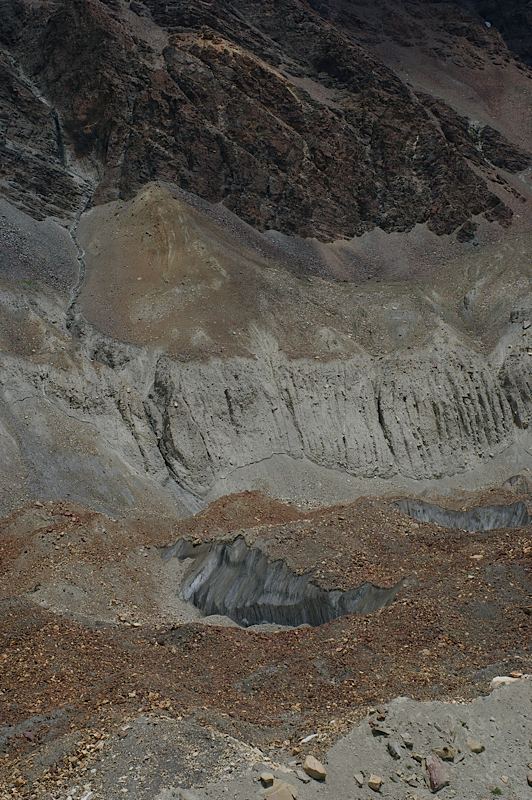
... which developed light and dark streaks as we headed further upstream and tributaries joined it:

Apparently something like seven glaciers merge at this point. The white glacier in the bottom right of this picture is from Bhagirathi II (according to Vishnu). The picture looks in the direction of our route for the next couple of days (we took a left turn under the glaciated black peak in the distance).
The tricky portion of the day's walk was our second glacier crossing -- this time it was the Bhagirathi II glacier mentioned above. It took a long time and much zigzagging to cross, and then there was a steep and tricky moraine wall to climb up (the porters helpfully fixed a rope like a handrail).
 | 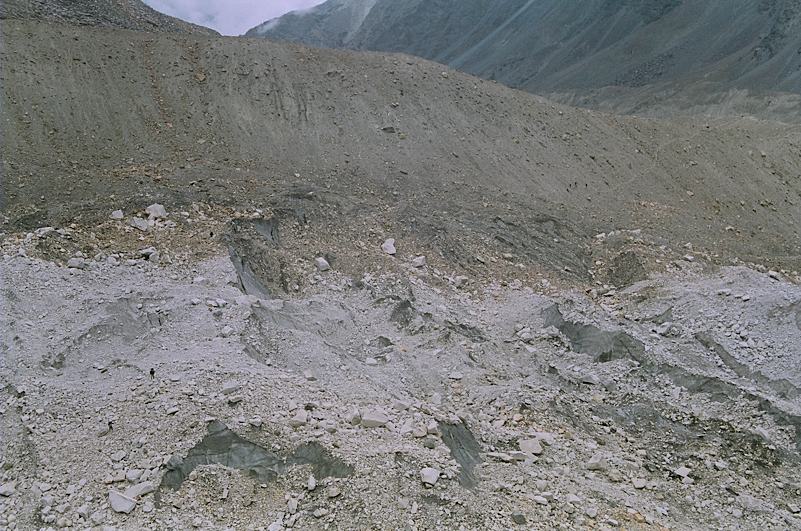 | 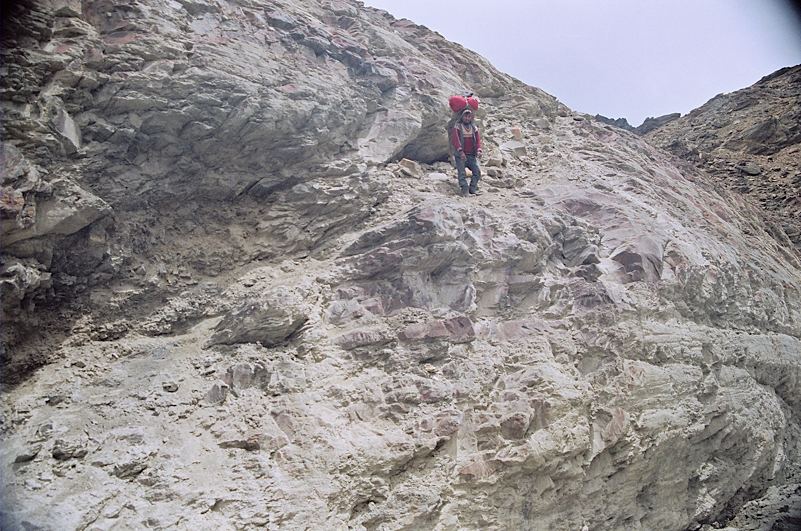 |
(Look closely at the second picture and you can make us out crossing over.)
This was the last hurdle of the day, and on the other side of the glacier lay a beautiful green meadow surrounding Vasuki Tal (~4900m). The tal (lake) itself was singularly unimpressive, more a cold, dull pond than anything else.
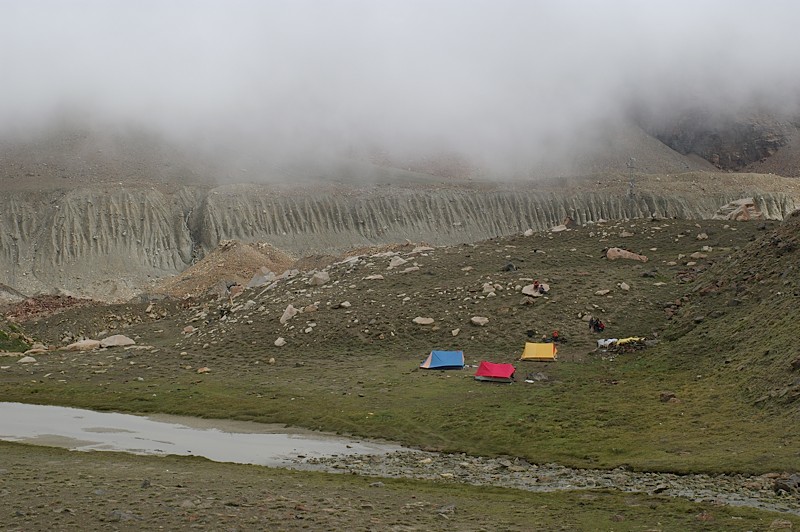
The itinerary that Vishnoi had copied off the net read:
"Today's trek of 7 km takes us to the stunning Vasuki tal with blocks of ice floating in it. Also see stunning reflections of the mighty peaks in its waters."Vladlen, whose Himalayan experience so far had chiefly consisted of cloud, fog, rubble and dull ice, kept repeating this caustically throughout the rest of the day. We ignored him and went off to climb some boulders.
(Part 6)
Subscribe to:
Posts (Atom)